
1. Characteristics of the curriculum
Feature: obligatory subject
Department: Department of Food Hygiene
Timing in the curriculum: Semester 9
Lectures/practical: 60/30 (at Semester 9)
Credit: 4 (at Semester 9)
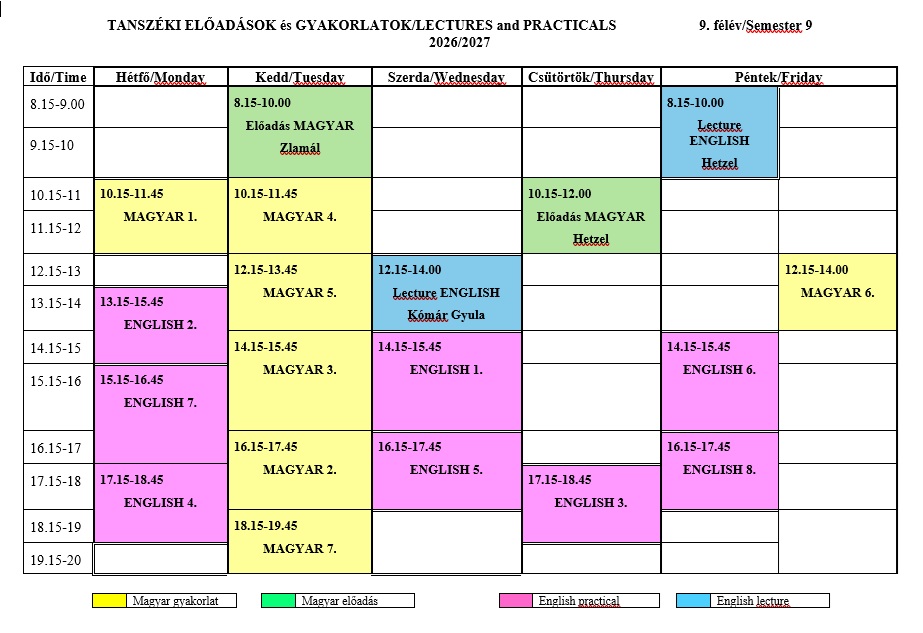
Lectures on Food Hygiene – 2026/27 Semester 9
Practicals on Food Hygiene – 2026/27 Semester 9
2. Topics
Lectures
In the framework of lectures the theoretical basis of the complex knowledge of hygiene conditions and legal requirements of production, processing and trade of wholesome foodstuffs are presented to develop the thinking and skill of Veterinary Public Health.
In Semester 9, the following topics will be discussed: general fundamentals of food hygiene include the basic terms, foodborne hazards and the potential adverse health, main aspects of food microbiology and chemical-toxicological food safety, risk assessment and risk management of microbiological and chemical risks, risk communication, basic knowledge on food spoilage and preservation, background of food-chain safety legal regulation, the general rules of food production, processing and marketing, food adulteration.
Practicals
The purpose of food hygiene practicals is to demonstrate the practical aspects of the theoretical knowledge discussed in the lectures as well as to carry out the manual exercise of certain technological processes, and to develop the practical skills necessary to develop a complex way of thinking about the safety of the food chain.
3. How to be prepared for and how execute the practicals
The base of group division is the list given by the secretariat of International Study Program. The total number of one group cannot exceed 18-20 students but cannot be less than 10 students.
The student should be arrived in time, in clean white-coat and well-prepared to the site of practicals.
Due to the actual pandemic situation of infectious diseases, all students must keep the actual regulations/rules (e. g. disinfection of hands when entering and leaving the practice room, wearing masks covering both nose and mouth during the whole practical time etc.).
In case of symptoms suggestive of fever, the student should not participate in the exercises.
4. The way of check of knowledge during the practicals
It may be performed in oral or written forms. It is primarily directed to the check of knowledge related to the given week-topic, but the topics of the previous weeks are also interrogated continuously.
5. How to supplement the practicals
The participation on the practical is obligatory. The number of the missed practicals can be max. four (4) practicals (including the 2 weeks obligatory clinical practice), above this the signature by the end of the semester will be denied.
It is important to note that all absences must be supported by official documentation (with the exception of the two aforementioned excused clinical practical, because it is certified directly towards the Department by the given clinical department).
Absences from practical sessions may only be made up during the educational period. Students may retake an absence by attending a session with another group during the same week, if there is a free seat, or during the final week of the educational period arranged time point in advance with their practical leader. Absences resulting from mandatory clinical shift/practicals must also be retaken.
The participation in practicals and the rules of retake is subjected to change based on the actual infectious pandemic situation, official bank holiday and Rectoral break.
6. Midterm tests, their evaluation, and their supplementation if necessary
During Semester 9, students will have two written (online) midterm tests. The materials of these tests are based on the previous topics of practicals and lectures up to the time of tests. The tests are evaluated with percentage values based of the total scores with a minimum passing score of 70%.
If any student is unable to complete the written assignment at the scheduled time due to reasons beyond their control it is required to report this to the department secretariat.
If any of the midterm tests is failed (<70%) or who failed to complete the written assessment for any reason and reported this fact to the Department, are required to retake an online test at a pre-arranged time. Altogether, there are two additional chances for retake. If a student fails to give advance notice that they are unable to take the test at the scheduled time, they may only retake the test personally at the department.
7. Signature by the end of the Semester, conditions of having a practical mark
Semester 9: Participation on the lectures is obligatory (according to the University’s SOP). Occasionally, the participation is checked by the lecturers. In the case of more than 3 missing lectures that are not certified, the signature of the semester will be refused.
Requirements for signature by the end of both semesters (Semester 9 and 10) are the participation in all the practicals and appropriate results of the two written midterm tests.
Semester 9: Practical mark: The practical course grade is calculated as an average of the midterm tests as follows: 70-77.99% = 2, passing; 78-85.99% = 3, fair; 86-93.99% = 4, good; 94-100% = 5, excellent.
If someone fails to meet the minimum requirement of 70% in case of any of the midterm tests, the practical course grade at the end of Semester 9 will be 1, i.e., failed.
If the mark is wished to be improved, it may be done in the exam period.
The conditions of having the credit points according to the curriculum are the signature by the end of the Semester and at least a practical course grade 2.
The participation in practicals and the rules of retake are subjected to change based on the actual infectious pandemic situation.
8. Exam requirements
Semester 9: no exam (practical course grade)
9. Suggested learning materials
Teaching materials:
Materials of lectures and practicals (e-learning system).
Supplementary materials:
Laczay, P: Food hygiene, food chain safety. Textbook, Budapest, 2014.
Erdősi, O.-Lányi, K.-Lehel, J.-Szili, Zs.: Food hygiene practicals I. A/3 Nyomdaipari és Kiadói Szolgáltató Kft., Budapest, 2016.
Erdősi, O.-Lányi, K.-Lehel, J.-Szili, Zs.: Food hygiene practicals II. A/3 Nyomdaipari és Kiadói Szolgáltató Kft., Budapest, 2017.
Budapest, 1st September 2026
Miklós Süth DVM, PhD
Head of Institute of Food Chain Science
Head of Department of Food Hygiene
Associate Professor
English
kötelező
gyakorlati jegy
5
1
4
60
30
Department of Food Hygiene (DFH)
Vet EN
Course description
1. Characteristics of the curriculum
Feature: obligatory subject
Department: Department of Food Hygiene
Timing in the curriculum: Semester 9
Lectures/practical: 60/30 (at Semester 9)
Credit: 4 (at Semester 9)
Lectures on Food Hygiene – 2026/27 Semester 9
Practicals on Food Hygiene – 2026/27 Semester 9
2. Topics
Lectures
In the framework of lectures the theoretical basis of the complex knowledge of hygiene conditions and legal requirements of production, processing and trade of wholesome foodstuffs are presented to develop the thinking and skill of Veterinary Public Health.
In Semester 9, the following topics will be discussed: general fundamentals of food hygiene include the basic terms, foodborne hazards and the potential adverse health, main aspects of food microbiology and chemical-toxicological food safety, risk assessment and risk management of microbiological and chemical risks, risk communication, basic knowledge on food spoilage and preservation, background of food-chain safety legal regulation, the general rules of food production, processing and marketing, food adulteration.
Practicals
The purpose of food hygiene practicals is to demonstrate the practical aspects of the theoretical knowledge discussed in the lectures as well as to carry out the manual exercise of certain technological processes, and to develop the practical skills necessary to develop a complex way of thinking about the safety of the food chain.
3. How to be prepared for and how execute the practicals
The base of group division is the list given by the secretariat of International Study Program. The total number of one group cannot exceed 18-20 students but cannot be less than 10 students.
The student should be arrived in time, in clean white-coat and well-prepared to the site of practicals.
Due to the actual pandemic situation of infectious diseases, all students must keep the actual regulations/rules (e. g. disinfection of hands when entering and leaving the practice room, wearing masks covering both nose and mouth during the whole practical time etc.).
In case of symptoms suggestive of fever, the student should not participate in the exercises.
4. The way of check of knowledge during the practicals
It may be performed in oral or written forms. It is primarily directed to the check of knowledge related to the given week-topic, but the topics of the previous weeks are also interrogated continuously.
5. How to supplement the practicals
The participation on the practical is obligatory. The number of the missed practicals can be max. four (4) practicals (including the 2 weeks obligatory clinical practice), above this the signature by the end of the semester will be denied.
It is important to note that all absences must be supported by official documentation (with the exception of the two aforementioned excused clinical practical, because it is certified directly towards the Department by the given clinical department).
Absences from practical sessions may only be made up during the educational period. Students may retake an absence by attending a session with another group during the same week, if there is a free seat, or during the final week of the educational period arranged time point in advance with their practical leader. Absences resulting from mandatory clinical shift/practicals must also be retaken.
The participation in practicals and the rules of retake is subjected to change based on the actual infectious pandemic situation, official bank holiday and Rectoral break.
6. Midterm tests, their evaluation, and their supplementation if necessary
During Semester 9, students will have two written (online) midterm tests. The materials of these tests are based on the previous topics of practicals and lectures up to the time of tests. The tests are evaluated with percentage values based of the total scores with a minimum passing score of 70%.
If any student is unable to complete the written assignment at the scheduled time due to reasons beyond their control it is required to report this to the department secretariat.
If any of the midterm tests is failed (<70%) or who failed to complete the written assessment for any reason and reported this fact to the Department, are required to retake an online test at a pre-arranged time. Altogether, there are two additional chances for retake. If a student fails to give advance notice that they are unable to take the test at the scheduled time, they may only retake the test personally at the department.
7. Signature by the end of the Semester, conditions of having a practical mark
Semester 9: Participation on the lectures is obligatory (according to the University’s SOP). Occasionally, the participation is checked by the lecturers. In the case of more than 3 missing lectures that are not certified, the signature of the semester will be refused.
Requirements for signature by the end of both semesters (Semester 9 and 10) are the participation in all the practicals and appropriate results of the two written midterm tests.
Semester 9: Practical mark: The practical course grade is calculated as an average of the midterm tests as follows: 70-77.99% = 2, passing; 78-85.99% = 3, fair; 86-93.99% = 4, good; 94-100% = 5, excellent.
If someone fails to meet the minimum requirement of 70% in case of any of the midterm tests, the practical course grade at the end of Semester 9 will be 1, i.e., failed.
If the mark is wished to be improved, it may be done in the exam period.
The conditions of having the credit points according to the curriculum are the signature by the end of the Semester and at least a practical course grade 2.
The participation in practicals and the rules of retake are subjected to change based on the actual infectious pandemic situation.
8. Exam requirements
Semester 9: no exam (practical course grade)
9. Suggested learning materials
Teaching materials:
Materials of lectures and practicals (e-learning system).
Supplementary materials:
Laczay, P: Food hygiene, food chain safety. Textbook, Budapest, 2014.
Erdősi, O.-Lányi, K.-Lehel, J.-Szili, Zs.: Food hygiene practicals I. A/3 Nyomdaipari és Kiadói Szolgáltató Kft., Budapest, 2016.
Erdősi, O.-Lányi, K.-Lehel, J.-Szili, Zs.: Food hygiene practicals II. A/3 Nyomdaipari és Kiadói Szolgáltató Kft., Budapest, 2017.
Budapest, 1st September 2026
Miklós Süth DVM, PhD
Head of Institute of Food Chain Science
Head of Department of Food Hygiene
Associate Professor
Lectures theme
LECTURES ON FOOD HYGIENE
Academic year 2025/2026, Semester 9
Wednesday 12:15-14:00 / Kómár lecture room
Friday 8:15-10:00 / Hetzel lecture room
| Week | Date | Topics | Name of Lecturer |
| 1 | 10/09
|
Introduction and history of food hygiene. One-health.
Food safety-food security. |
Miklós Süth
|
| 12/09 | The food arena. The “good” food. | László Búza | |
| 2 | 17/09 | Introduction to food chain risks. Basics of risk assessment. Risk-benefit analysis. | Ákos Jóźwiak |
| 19/09 | Basic principles of food law. Legal regulation of the food economy. | Gyula Kasza | |
| 3 | 24/09 | Food chain control system, traceability, responsibility in the food chain. | Tibor Kocsner |
| 26/09 | Basics of the food microbiology. Growth and destruction of microbes. | Attila Nagy | |
| 4 | 01/10 | Microbiological diagnostic options in food industry. Predictive microbiology. | Tekla Engelhardt |
| 03/10 | Bacteria that cause foodborne infections. | Zsuzsanna Lancz | |
| 5 | 08/10 | Bacteria that cause food poisoning, other microorganisms that cause food -borne diseases (viruses, yeast, molds and parasites) | Slaven Grbic |
| 10/10 | Microbial spoilage. Application of microorganisms in food industry. | Tekla Engelhardt | |
| 6 | 15/10 | Reduction of microbiological risks in food industry. | Tekla Engelhardt |
| 17/10 | Disinfection in food industry. | Zsuzsanna Lancz | |
| 7 | 22/10 | Chemical-toxicological food safety: veterinary medicinal products (VMP) and prohibited substances. | József Lehel
|
| 8 | 29/10 | Chemical-toxicological food safety: technological pollutants.
Contaminants of biological origin I. (mycotoxins, fungal toxins) |
Dániel Pleva |
| 31/10 | Chemical-toxicological food safety: environmental and agricultural originated contaminants of food. | Katalin Lányi
|
|
|
9 |
05/11 | Chemical-toxicological food safety: toxic substances of natural origin. Contaminants of biological origin II. (marine and freshwater biotoxins). | József Lehel
|
| 07/11 | Sampling strategies in the food chain. Monitoring systems. | Attila Nagy | |
|
10 |
12/11 | Control of chemical contaminations. Reduction of chemical risks. | Ákos Jóźwiak |
| 14/11 | Prerequisite programs. GAP, GMP, GHP. | Miklós Süth | |
| 11 | 21/11
7:15 |
Basic knowledge of HACCP system.
Implementation of the HACCP system. |
Slaven Grbic |
|
12 |
26/11 | Food allergy and food intolerance. Consious nutrition, nutritional awareness. | Béla Gyetvai |
| 28/11 | Food adulteration. | László Búza | |
|
13 |
03/12 | Investigation of food chain safety incidents.
Diagnosis and management of food-borne/mediated diseases. |
László Búza |
| 05/12 | Risk management. | Ákos Jóźwiak | |
| 14 | 10/12 | Risk communication. | Gyula Kasza |
| 12/12 | Sustainability in the food chain. Food waste – problems and solutions. | Gyula Kasza |
Practical lessons theme
Food hygiene practicals
Academic year 2025/2026, Semester 9
Place of practical: building “C”, floor 2
| Week | Date | Topics | Supervisor | Instructor |
| 1 | 08-12. 09. | Aims and requirements of practicals, occupational health rules. | József Lehel
Katalin Lányi |
Lívia Darnay
Tekla Engelhardt Máté Farkas Tünde Kanyorszky Orsolya Strang |
| 2 | 15-19. 09. | Food hygiene significance and examination of water.
.
|
Tekla Engelhardt | Lívia Darnay
Tekla Engelhardt Máté Farkas Tünde Kanyorszky Orsolya Strang |
| 3 | 22-26. 09. | Food packaging and labelling. | Lívia Darnay | Lívia Darnay
Tekla Engelhardt Máté Farkas Tünde Kanyorszky Orsolya Strang |
| 4 | 29.09- 03.10 | Microbiological sampling for official and other purposes.
Food microbiological criteria – application of 2073/2005 EC regulation. |
Tekla Engelhardt |
Lívia Darnay
Tekla Engelhardt Máté Farkas Tünde Kanyorszky Orsolya Strang |
| 5 | 06-10. 10. | Classic methods in the food microbiology. From sampling to cultivation. |
Tekla Engelhardt |
Lívia Darnay
Tekla Engelhardt Máté Farkas Tünde Kanyorszky Orsolya Strang |
| 6 | 13-17. 10. | Rapid methods in the food microbiology |
Tekla Engelhardt |
Lívia Darnay
Tekla Engelhardt Máté Farkas Tünde Kanyorszky Orsolya Strang |
| 7 | 20-24. 10. | Detection of pathogens from food (Salmonella detection)
|
Tekla Engelhardt |
Lívia Darnay
Tekla Engelhardt Máté Farkas Tünde Kanyorszky Orsolya Strang |
| 8 | 27-31.10. | Molecular methods in food microbiology.
Evaluation of the PCR results (Salmonella) |
Tekla Engelhardt |
Lívia Darnay
Tekla Engelhardt Máté Farkas Tünde Kanyorszky Orsolya Strang |
| 9 | 03-07. 11 | Trichinella testing. Comparison of microbiological test results.
|
Tekla Engelhardt
|
Lívia Darnay
Tekla Engelhardt Máté Farkas Tünde Kanyorszky Orsolya Strang |
| 10 | 10-14. 11. | Chemical-toxicological food safety: sample preparation, screening investigations, confirmatory, large instrument analysis. | Katalin Lányi
József Lehel |
Lívia Darnay
Tekla Engelhardt Máté Farkas Tünde Kanyorszky Orsolya Strang |
| 11 | 17-21. 11. | HACCP system: case studies.
|
Ákos Jóźwiak | Lívia Darnay
Tekla Engelhardt Máté Farkas Tünde Kanyorszky Orsolya Strang |
| 12 | 24.-28. 11. | HACCP system building in practice. | Ákos Jóźwiak
|
Lívia Darnay
Tekla Engelhardt Máté Farkas Tünde Kanyorszky Orsolya Strang |
| 13 | 01- 05. 12. | Risk management: case studies. | Ákos Jóźwiak | Lívia Darnay
Tekla Engelhardt Máté Farkas Tünde Kanyorszky Orsolya Strang |
| 14 | 08-12. 12. | Supplementary practical. | Lívia Darnay
Tekla Engelhardt Máté Farkas Tünde Kanyorszky Orsolya Strang |
Date of midterm tests: 1st midterm test: on the week 6, 2nd midterm test: on the week 11.
Evaluation description