
1.1. Characteristics of the curriculum
Feature: obligatory subject
Timing in the curriculum: Semester 10
Lectures/practical: 60/30
Credit: 6
1.2. Topics
Lectures
In the framework of lectures the theoretical basis of the complex knowledge of hygiene conditions and legal requirements of production, processing and trade of wholesome foodstuffs are presented to develop the thinking and skill of Veterinary Public Health.
In Semester 10 the food chain safety tasks with a one health approach will be presented, focusing on production chains. Initially, the ruminant production chain will be discussed including milk hygiene (production and processing) built on the previous fundamentals, then during the topics of meat hygiene the different production chains – cattle and other ruminants, swine, poultry, fish and other animals production chain – will be summarized, furthermore the processing hygiene and safety aspects of foodstuffs of plant origin, alcoholic and non-alcoholic beverages and meat substitutes will be summarized. Special attention will be paid to meat inspection, animal welfare of food-producing animals, to present the food processing technology of foods of animal and plant origin, and to make known the processing hygiene aspects of them.
Practicals
The purpose of food hygiene practicals is to demonstrate the practical aspects of the theoretical knowledge discussed in the lectures as well as to carry out the manual exercise of certain technological processes, and to develop the practical skills necessary to develop a complex way of thinking about the safety of the food chain.
1.3. How to be prepared for and how execute the practicals
The base of group division is the list given by the secretariat of International Study Program. The total number of one group cannot exceed 18 students. The student should be arrived in time, in clean white-coat and well-prepared to the site of practicals.
Due to the actual pandemic situation of COVID-19 or other infectious diseases, all students must keep the actual regulations/rules (e. g. disinfection of hands direct prior to start of practicals, wearing masks covering both nose and mouth during the whole practical time etc.). In case of symptoms suggestive of fever or suspected Covid disease, the student should not participate in the exercises.
1.4. The way of check of knowledge during the practicals
It may be performed in oral or written forms. It is primarily directed to the check of knowledge related to the given week-topic, but the topics of the previous weeks are also interrogated continuously.
1.5. How to supplement the practicals
If somebody is not able to participate on the practical in the right time, the supplementation is possible during the semester at a time point agreed upon with the instructor of the given practical in advance in written form (via e-mail). Supplementation of missing because of the obligatory clinical practice (2 weeks) is not needed. It is certified directly towards the Department by the given clinical department. The number of the missed practicals can be max. four (4) practicals (including the 2 weeks obligatory clinical practice), above this the signature by the end of the semester will be denied.
The participation in practicals and the rules of retake are subjected to change based on the actual pandemic situation of COVID-19 or another infectious pandemic situation.
1.6. Midterm tests, their evaluation, and their supplementation if necessary
During Semester 10, there will be two written midterm tests, as well based on the topics of the lectures and the practicals up to the time of tests. A minimum of 60% should be reached to pass the tests. If any of the midterm tests is failed or the student was not able to participate, he/she must write a supplementary midterm test at least up to the end of the semester. Altogether, there are two additional chances for retake. If someone fails to meet the minimum requirement of 60% in case of any of the midterm tests, the signature at the end of the semester will be denied.
1.7. Signature by the end of the Semester, conditions of having a practical mark
Participation on the lectures is obligatory (according to the University’s SOP). Occasionally, the participation is checked by the lecturers. In the case of more than 3 missing lectures that are not certified, the signature of the semester will be refused. Requirements for signature by the end of both semesters (Semester 9 and 10) are the participation in all the practicals and appropriate results of the two written midterm tests. The condition of having the signature is the participation in the lectures and the practicals, and the minimum 60% fulfillment of both midterm tests.
The participation in practicals and the rules of retake are subjected to change based on the actual pandemic situation of COVID-19 or another infectious pandemic situation.
1.8. Exam requirements
Semester 10: final exam based on the materials of Semesters 9 and 10.
The final exam consists of two parts. The first one is a written exam that includes the materials of the lectures and practices of both semesters 9 and 10, whereas the second, oral exam is focused on the most important topics of the one-day competence. Both part-exams will be assessed with marks between 1 and 5 the average of which gives the final mark of the exam. The written part of the exam will be evaluated as follows: 60-69,9% = 2, passing, 70-79,9% = 3, fair, 80-89,9% = 4, good, 90-100% = 5, excellent. Both the written and the oral parts of the exam must be passed. If the written part is failed, the student cannot follow the exam with the oral part, i. e. the precondition of the oral exam is to pass the written part. However, if the oral part is unsatisfactory, only this part should be retaken. If the result of the written and/or oral exam is unsatisfactory, the next exam is considered as a retake exam.
The oral part of the exam is evaluated as unsatisfactory (1=failed) if there are significant gaps in the knowledge of the student on the topic in relation to the one-day competence. At the oral exam, students draw two questions from the previously published list of questions:
Questions of the final oral exam are available in the e-learning (Moodle) system.
1.9. Learning materials
Materials of lectures and practicals.
Laczay, P: Food hygiene, food chain safety. Textbook, Budapest, 2014.
Erdősi, O.-Lányi, K.-Lehel, J.-Szili, Zs.: Food hygiene practicals I. A/3 Nyomdaipari és Kiadói Szolgáltató Kft., Budapest, 2016.
Erdősi, O.-Lányi, K.-Lehel, J.-Szili, Zs.: Food hygiene practicals II. A/3 Nyomdaipari és Kiadói Szolgáltató Kft., Budapest, 2017.
1.10. Lectures and practicals of the department
English
kötelező
szigorlat
5
2
6
60
30
Department of Food Hygiene (DFH)
Vet EN
Course description
1.1. Characteristics of the curriculum
Feature: obligatory subject
Timing in the curriculum: Semester 10
Lectures/practical: 60/30
Credit: 6
1.2. Topics
Lectures
In the framework of lectures the theoretical basis of the complex knowledge of hygiene conditions and legal requirements of production, processing and trade of wholesome foodstuffs are presented to develop the thinking and skill of Veterinary Public Health.
In Semester 10 the food chain safety tasks with a one health approach will be presented, focusing on production chains. Initially, the ruminant production chain will be discussed including milk hygiene (production and processing) built on the previous fundamentals, then during the topics of meat hygiene the different production chains – cattle and other ruminants, swine, poultry, fish and other animals production chain – will be summarized, furthermore the processing hygiene and safety aspects of foodstuffs of plant origin, alcoholic and non-alcoholic beverages and meat substitutes will be summarized. Special attention will be paid to meat inspection, animal welfare of food-producing animals, to present the food processing technology of foods of animal and plant origin, and to make known the processing hygiene aspects of them.
Practicals
The purpose of food hygiene practicals is to demonstrate the practical aspects of the theoretical knowledge discussed in the lectures as well as to carry out the manual exercise of certain technological processes, and to develop the practical skills necessary to develop a complex way of thinking about the safety of the food chain.
1.3. How to be prepared for and how execute the practicals
The base of group division is the list given by the secretariat of International Study Program. The total number of one group cannot exceed 18 students. The student should be arrived in time, in clean white-coat and well-prepared to the site of practicals.
Due to the actual pandemic situation of COVID-19 or other infectious diseases, all students must keep the actual regulations/rules (e. g. disinfection of hands direct prior to start of practicals, wearing masks covering both nose and mouth during the whole practical time etc.). In case of symptoms suggestive of fever or suspected Covid disease, the student should not participate in the exercises.
1.4. The way of check of knowledge during the practicals
It may be performed in oral or written forms. It is primarily directed to the check of knowledge related to the given week-topic, but the topics of the previous weeks are also interrogated continuously.
1.5. How to supplement the practicals
If somebody is not able to participate on the practical in the right time, the supplementation is possible during the semester at a time point agreed upon with the instructor of the given practical in advance in written form (via e-mail). Supplementation of missing because of the obligatory clinical practice (2 weeks) is not needed. It is certified directly towards the Department by the given clinical department. The number of the missed practicals can be max. four (4) practicals (including the 2 weeks obligatory clinical practice), above this the signature by the end of the semester will be denied.
The participation in practicals and the rules of retake are subjected to change based on the actual pandemic situation of COVID-19 or another infectious pandemic situation.
1.6. Midterm tests, their evaluation, and their supplementation if necessary
During Semester 10, there will be two written midterm tests, as well based on the topics of the lectures and the practicals up to the time of tests. A minimum of 60% should be reached to pass the tests. If any of the midterm tests is failed or the student was not able to participate, he/she must write a supplementary midterm test at least up to the end of the semester. Altogether, there are two additional chances for retake. If someone fails to meet the minimum requirement of 60% in case of any of the midterm tests, the signature at the end of the semester will be denied.
1.7. Signature by the end of the Semester, conditions of having a practical mark
Participation on the lectures is obligatory (according to the University’s SOP). Occasionally, the participation is checked by the lecturers. In the case of more than 3 missing lectures that are not certified, the signature of the semester will be refused. Requirements for signature by the end of both semesters (Semester 9 and 10) are the participation in all the practicals and appropriate results of the two written midterm tests. The condition of having the signature is the participation in the lectures and the practicals, and the minimum 60% fulfillment of both midterm tests.
The participation in practicals and the rules of retake are subjected to change based on the actual pandemic situation of COVID-19 or another infectious pandemic situation.
1.8. Exam requirements
Semester 10: final exam based on the materials of Semesters 9 and 10.
The final exam consists of two parts. The first one is a written exam that includes the materials of the lectures and practices of both semesters 9 and 10, whereas the second, oral exam is focused on the most important topics of the one-day competence. Both part-exams will be assessed with marks between 1 and 5 the average of which gives the final mark of the exam. The written part of the exam will be evaluated as follows: 60-69,9% = 2, passing, 70-79,9% = 3, fair, 80-89,9% = 4, good, 90-100% = 5, excellent. Both the written and the oral parts of the exam must be passed. If the written part is failed, the student cannot follow the exam with the oral part, i. e. the precondition of the oral exam is to pass the written part. However, if the oral part is unsatisfactory, only this part should be retaken. If the result of the written and/or oral exam is unsatisfactory, the next exam is considered as a retake exam.
The oral part of the exam is evaluated as unsatisfactory (1=failed) if there are significant gaps in the knowledge of the student on the topic in relation to the one-day competence. At the oral exam, students draw two questions from the previously published list of questions:
Questions of the final oral exam are available in the e-learning (Moodle) system.
1.9. Learning materials
Materials of lectures and practicals.
Laczay, P: Food hygiene, food chain safety. Textbook, Budapest, 2014.
Erdősi, O.-Lányi, K.-Lehel, J.-Szili, Zs.: Food hygiene practicals I. A/3 Nyomdaipari és Kiadói Szolgáltató Kft., Budapest, 2016.
Erdősi, O.-Lányi, K.-Lehel, J.-Szili, Zs.: Food hygiene practicals II. A/3 Nyomdaipari és Kiadói Szolgáltató Kft., Budapest, 2017.
1.10. Lectures and practicals of the department
Lectures theme
Food Hygiene 2 – LECTURES
Academic year 2025/2026, Semester 10
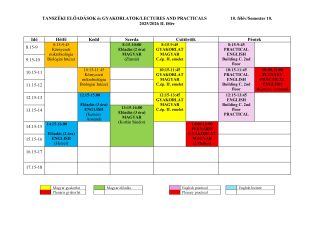
Monday 14.15-16.00 Hetzel, Tuesday 12.15-15.00 Kemény Armand Lecture Hall
| Week | Date | Topics | Supervisor | Lecturer |
| 1. | 02.02.
(2 hours) |
Food chain safety aspects of milk: Introduction
|
Ákos Jóźwiak | Katalin Lányi |
| 03.02.
(3 hours) |
Food chain safety aspects of milk: Milk production
|
Ákos Jóźwiak | Lívia Darnay | |
| 2. | 09.02.
(2 hours) |
Food chain safety aspects of milk: Milk processing
|
Ákos Jóźwiak | Ákos Jóźwiak |
| 10.02.
(3 hours) |
Food chain safety aspects of milk: Safety and Sustainability
|
Ákos Jóźwiak | Tekla Engelhardt | |
| 3. | 16.02.
(2 hours) |
Processing of alternative proteins, processing hygiene, food safety control | András Tóth | András Bittsánszky |
| 17.02.
(3 hours) |
Hygiene of egg production and the manufacture of egg-products, inspection of eggs and egg-products, food safety control | Tekla Engelhardt | Tekla Engelhardt | |
| 4. | 23.02.
(2 hours) |
Production and processing hygiene of foodstuffs of plant origin (vegetables, fruits) | Tekla Engelhardt | Tekla Engelhardt |
| 24.02.
(3 hours) |
Production and processing hygiene of foodstuffs of plant origin (cereals, baking products) | Tekla Engelhardt | Tekla Engelhardt | |
| 5. | 02.03.
(2 hours) |
Hygiene conditions and official control of production and processing of fresh water fish and of their products | József Lehel | József Lehel |
| 03.03.
(3 hours) |
Hygiene conditions and official control of production and processing of marine fish and live bivalve molluscs, and of their products | József Lehel | József Lehel | |
| 6. | 09.03.
(2 hours) |
The arena of pork production – the slaughterhouse (the facility, technology, natural and legal environment, animals, people, animal welfare expectations, official control) | László Búza | László Búza |
| 10.03.
(3 hours) |
The arena of pork production – events until the slaughterhouse (farm, technology, natural and legal environment, animals, people, veterinary decisions) | László Búza | László Gombos | |
| 7. | 16.03.
(2 hours) |
The arena of pork production – meat processing (facilities, technologies, natural and legal environment, basic materials, additives and packaging materials, people, veterinary decisions | László Búza | László Búza |
| 17.03.
(3 hours) |
The arena of pork production – prevention and management of pork/food incidents (public health and epidemiological biosecurity) (operating license, audit, meat inspection for infectious diseases and zoonoses, veterinary decisions, measures) | László Búza
|
László Búza
|
|
| 8. | 23.03.
(2 hours) |
VPH aspects of the ruminant meat production line I. (integrated meat inspection, hygiene of the slaughtering) | Tibor Kocsner | Dániel Pleva |
| 24.03.
(3 hours) |
VPH aspects of the ruminant meat production line II. (Post Mortem inspection, decision-making (judgement) and the by-product manegement) | Tibor Kocsner | Dániel Pleva | |
| 9. | SPRING BREAK | |||
| 10 | 07.04
(3 hours) |
Game processing and the rabbit production line | Tibor Kocsner | Tibor Kocsner |
| 11. | 13.04.
(2 hours) |
The system of the small-scale, local and marginal food production
Primary production |
Tibor Kocsner | Tekla Engelhardt |
| 14.04.
(3 hours) |
Production of non-alcoholic and alcoholic beverages, hygiene of their production, food safety control, special food safety incidents | Lívia Darnay
|
Lívia Darnay
|
|
| 12. | 20.04.
(2 hours) |
Safety aspects of the poultry production chain, meat inspection and meat judgement | Miklós Süth
|
Máté Farkas
|
| 21.04.
(3 hours) |
Complex inspection of food business operators
|
Miklós Süth | Miklós Süth | |
| 13. | 27.04
(2 hours) |
Official control of public catering and restaurants
|
András Tóth | András Bittsánszky |
| 28.04
(3 hours) |
VR training / Final exam consultation | Tibor Kocsner | Staff |
Practical lessons theme
Food Hygiene 2 – PRACTICALS
Academic year 2025/2026, Semester 10
Place of practicals: building C, 2nd floor (practical room) and
from 10:00-12:00 Plenary practical in Kemény Armand Lecture Hall building C.
| Week | Date | Topics | Supervisor | Instructor
|
| 1 | 06. 02. | Group 1-3 Physical and chemical properties of milk. Inspection aspects, tests and methods for the implementation of heat treatment procedure | Katalin Lányi | Lívia Darnay
Máté Farkas Tünde Kanyorszky Orsolya Strang |
| Group 4-6 Plenary practice:
Apiary products and their examination |
Lívia Darnay | Lívia Darnay | ||
| 2 | 13. 02. | Group 4-6 Physical and chemical properties of milk. Inspection aspects, tests and methods for the implementation of heat treatment procedure | Katalin Lányi
|
Lívia Darnay
Máté Farkas Tünde Kanyorszky Orsolya Strang |
| Group 1-3 Plenary practice:
Apiary products and their examination |
Lívia Darnay
|
Lívia Darnay
|
||
| 3 | 20.02. | Group 1-3 Inspection of egg and egg-products, marking of egg | Tekla Engelhardt | Lívia Darnay
Máté Farkas Tekla Engelhardt Orsolya Strang |
| Group 4-6 Plenary practice: Technological and food hygiene aspects of production of dairy products | Lívia Darnay
|
Lívia Darnay
|
||
| 4 | 27.02. | Group 4-6 Inspection of egg and egg-products, marking of egg | Tekla Engelhardt | Lívia Darnay
Máté Farkas Tekla Engelhardt Orsolya Strang |
| Group 1-3 Plenary practice: Technological and food hygiene aspects of production of dairy products | Lívia Darnay | Lívia Darnay | ||
| 5 | 06. 03.
|
Group 1-3 Meat inspection of fish and other aquatic animals, and fishery products | József Lehel | Lívia Darnay
Máté Farkas Tünde Kanyorszky Orsolya Strang |
| Group 4-6 Plenary practice: Technological and food hygiene aspects of production of meat products | Lívia Darnay | Lívia Darnay | ||
| 6 | 13. 03. | Group 1-4 External practice
|
László Búza | local specialists/
instructors |
| Group 5-6 Plenary practice:
Ageing and spoilage of meat |
Tibor Kocsner | Tünde Kanyorszky | ||
| 7 | 20. 03 | Group 3-6 External practice
|
László Búza
|
local specialists/
instructors |
| Group 1-2 Plenary practice:
Ageing and spoilage of meat |
Tibor Kocsner | Tünde Kanyorszky | ||
| 8 | 27.03 | Group 4-6 Meat inspection of fish and other aquatic animals, and fishery products | Lehel József | Lívia Darnay
Máté Farkas Tünde Kanyorszky Orsolya Strang |
| Group 1-3 Plenary practice: Technological and food hygiene aspects of production of meat products | Lívia Darnay
|
Lívia Darnay
|
||
| 9 | 30.03-06.04 | SPRING BREAK | ||
| 10 | 10.04. | Group 1-2 &5-6 External practice
|
László Búza | local specialists/
instructors |
| Group 3-4 Plenary practice:
Ageing and spoilage of meat |
Tibor Kocsner | Tünde Kanyorszky | ||
| 11 | 17.04 | Group 1-3 VR individual selection | Tibor Kocsner |
Instructors
|
| 12 | 24.04 | Group 4-6 VR individual selection | Tibor Kocsner |
Instructors
|
| 13 | 27-30.04. | SUPPLEMENTARY PRACTICALWEEK |
Date of midterm tests: 1st midterm test: on week 6, 2nd midterm test: on week 13