
I interviewed Professor László Fodor on the occasion of his 70th birthday, when, as he put it, he „finished working full-time.” Even so, he still has numerous professional commitments. Just a week before our meeting, at the Szent-Iványi – Binder Day ceremony, he gave a laudation for virologist Dr. Péter Malik, who was awarded the Hőgyes-Aujeszky Prize. The day after the interview, I saw him as the first person to arrive at István Street after the doorman: he was giving a lecture in the Tolnay Hall. In this English summary, we present the highlights of our conversation.
GUSZTÁV BALÁZS
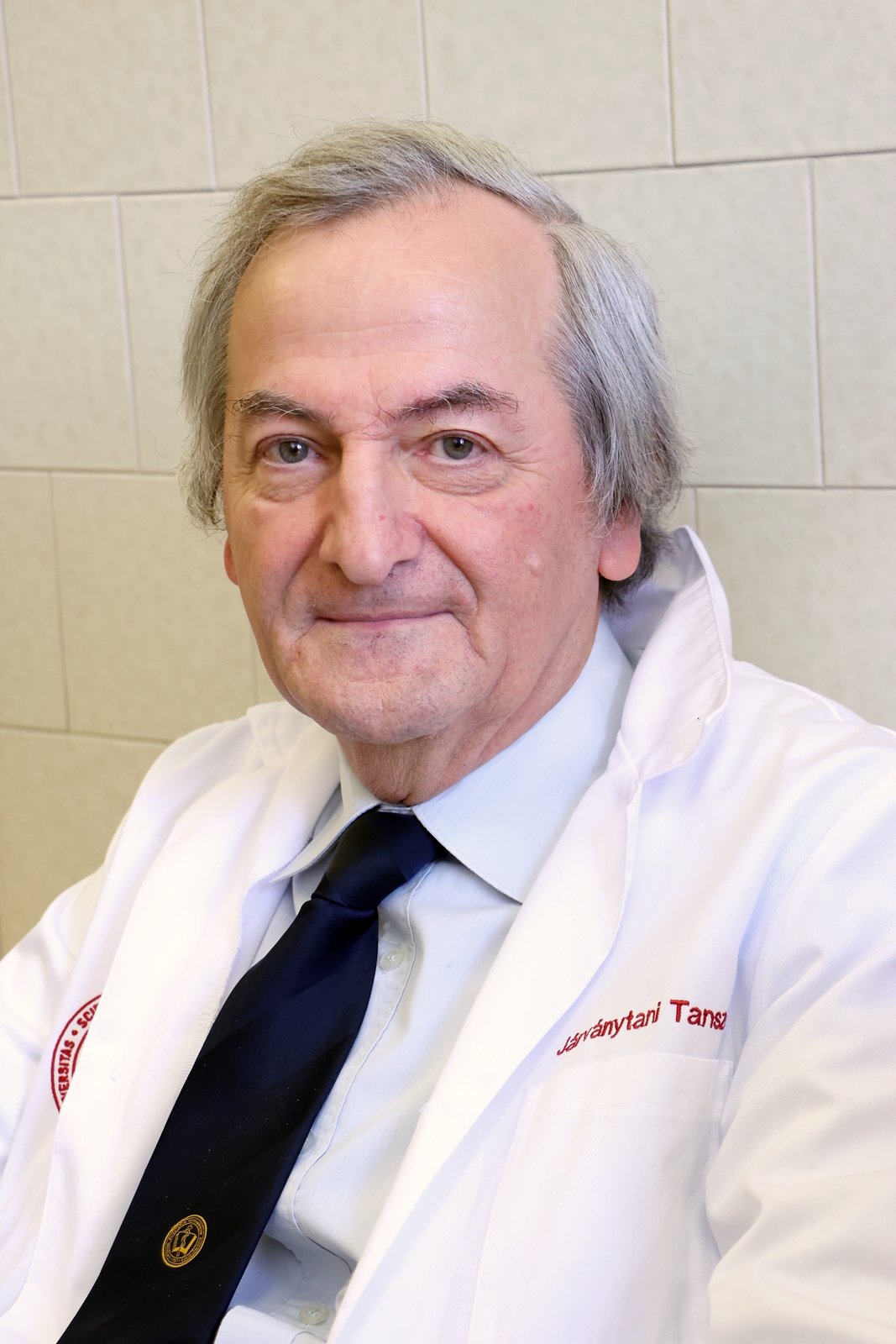 – Although I was born in Budapest and live here too, my roots are in the countryside. After World War II, my mother’s relatives were scattered across 13 countries. It was not secure to live as a Hungarian in the Banat region of Yugoslavia. My father’s family from Kunhegyes were „redeemed” citizens in the Jászkun District, which was established in 1279 as an autonomous administrative unit for the Jassic and Cumans. In 1702, Emperor Leopold I pledged the district to the Teutonic Order. The movement launched to regain their freedoms led to the Jászkun Redemption in 1745. After years of fundraising, the inhabitants bought back their privileges, securing land for themselves and future generations. This is how my ancestors became redeemed citizens, who lived as farmers, breeding animals – mainly sheep.
I had decided even before high school that I would become a veterinarian; the knowledge I gained in the biology study group at the József Attila Grammar School also helped me gain admission.
– You were awarded your doctorate degree summa cum laude at our university in 1979. What path led you to your research and teaching career?
– Originally, I was going to become a practicing veterinarian. But I was also a TDK (Scientific Students’ Association) member, and my supervisor, Dr. Barna Sas, who worked at the Phylaxia Biologicals Co. but also taught Physiology, was given the chance by the state-owned company to establish a laboratory for nutritional biochemistry and toxicology. He said he needed people he knew, had worked with, and got along well with. He thought of me too, and I accepted his invitation, taking a position at the company as a veterinary researcher. Less than two years later, the ministry conducted a „profile streamlining” at Phylaxia. The head of the lab was transferred to the National Veterinary Institute, and I was left looking for a job. Word of this reached academician Professor Tamás Szent-Iványi, who was looking for a specialist in bacteriology. I consider it one of the greatest gifts of my life that I had the chance to work with him for five years. He assigned me to the laboratory of Dr. János Varga, that time senior lecturer, now a member of the Hungarian Academy of Science, from whom I gained a lot both professionally and personally.
Even as a student, I was already fascinated by infectious diseases, largely thanks to my excellent teachers. The world of pathogens and infectious diseases is fascinating, each with its own logic. The properties of pathogens determine how they spread, how immunogenic they are, and how capable the body is of developing defence against them. And this determines everything! The course of disease, diagnosis, symptoms, lesions, and the possibilities of prevention and vaccination.
– Human and veterinary medicine go hand in hand in control of infectious diseases. But what differences would you call our attention to?
– In the broad areas of veterinary work, a holistic, herd-focused approach is indispensable.
In human medicine, due to the high level of specialization, everyone focuses on their own field, and it’s harder to view a disease in its broader context.
We always have to look at the whole animal. If we have a sharp eye, we can gather a wealth of information about the patient. Right from the beginning of veterinary education, infectious diseases were taught with great emphasis. Professor Ferenc Hutÿra developed the comprehensive teaching system still followed today. The spirit of this system is also reflected in the textbook Special Pathology and Therapeutics of the domestic animals by Hutÿra, Marek, Manninger, and Mócsy.
– You led the Department of Microbiology and Infectious Diseases for 24 years. Between 1997 and 2004, you were Vice-Rector and Vice Dean for International Affairs, then served as Dean of the Faculty from 2004 to 2012. What do you consider your greatest achievement?
– I have never taken stock of my life. In line with university tradition, I believe the most important thing is to create an atmosphere in the department and at the university where everyone feels well and is committed to the institution. I’m convinced that everyone can give their best when they work in a good atmosphere where they enjoy what they do.