
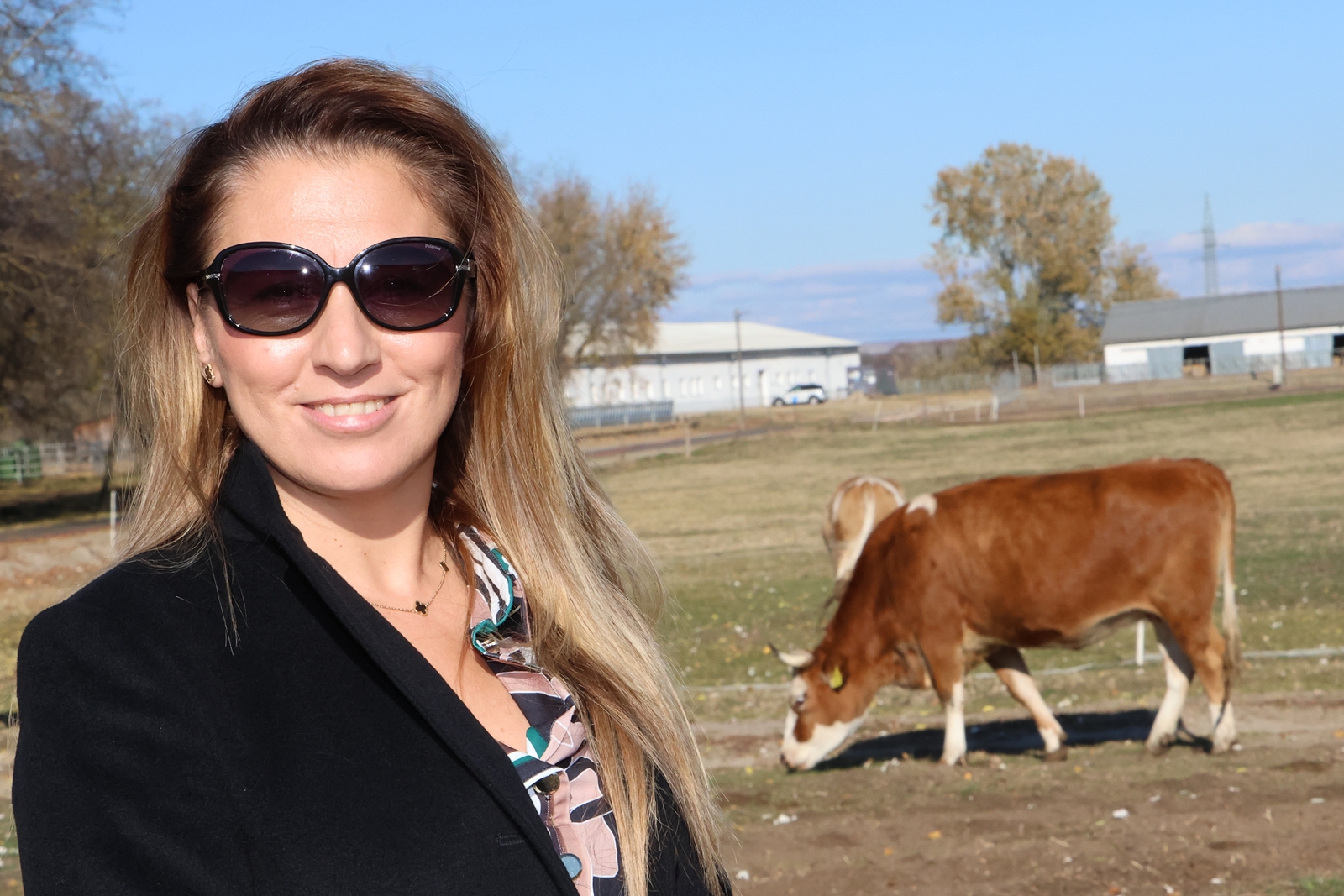
The director of the university’s training farm, Anett Sinka, grew up in Martonvásár, a market town that plays a defining role in both plant breeding and cultural history. The walls of the Brunszvik Mansion once welcomed Beethoven as a guest, and that tradition still weaves vibrantly through the town’s musical life today. The director studied piano at the Beethoven Music Primary School along with her brother, and during summer breaks they worked detasseling corn at the Martonvásár research institute.
GUSZTÁV BALÁZS
– My love for agriculture developed in Mosonmagyaróvár, at the renowned Academy. I studied agricultural economics as an agricultural engineer – under the old linear training system – specialising in the highly popular EU programme. I gained farm experience in Germany. That’s when I fell in love with cattle breeding, which later became the subject of my thesis at the Bos-Genetic artificial insemination centre. Oh, what the future held for me! Today, that farm is part of our training facility, under the leadership of Roland Raffer.
 – What are the characteristic features of the teaching farm?
– Our total area covers 897 hectares: 267 hectares of this is grassland– pastures and hayfields – while the rest is arable land. Between Maglód and Pécel, we have over 100 hectares of high-quality cropland. Our main responsibility is to meet the feed needs of our livestock. Grazing is already in place for the horses, cattle, and sheep. On the remaining land, we follow crop rotation, paying attention to securing the maximum possible agricultural subsidies. When it comes to applying for agricultural subsidies, we are supported by our colleague Réka Zentai, whose extensive experience ensures that we always make the most of the funding system. The background material for the management diary is provided by our inventory manager, Ferenc Nagy.
Üllő has sandy soil, so one of my first decisions was to stop selling organic manure – it’s simply too valuable to let go. We return it to the soil to improve its structure and retain moisture.
– How important does university leadership consider the work being done at Dóra Farm?
– The Rector’s expectations are motivating and creative, and he also provides the necessary resources. We share the belief that the farm must be managed with the care of a good steward – without that, no progress can be achieved anywhere.
Our commitments are wide-ranging. The Large Animal Veterinary Teaching Hospital used to buy animals from external businesses for teaching purposes. The University paid to ensure that cows close to calving would be available for caesarean section practice. Now, we “produce” this herd ourselves, and the cattle return to us a few weeks after teaching is done. We also supply the Equine Clinic and the Bos-Genetic facility in Ráckeresztúr with bulk feed and bedding straw.
Next year, we hope to produce the clinic’s entire annual need of 500 bales. With the Rector’s permission, we began renovating the grasslands and rebuilding the roofs of the sheep barns.
Last year we renovated the Cifra stable in the boarding horse yard, and this year we renewed the Cserepes stable. We were also given the opportunity to buy three horses to support teaching. Beyond the six-week practical training block, students could also visit Üllő during the summer break, and those who were interested received riding instruction. Our obstacle course is also available to students and boarding horse owners.
The cattle, pig, and poultry section is managed by Irén Kaszta; the equine unit by Attila Kaszta; and sheep farming by Gábor Kalina. The entire animal husbandry division is overseen by Péter Pálinkás and Csaba Puskás.
The training farm’s veterinarians are Dr. Levente Harmat and Dr. Petra Novinszky. Dr. Harmat is in charge of on-duty week practicals, supported by Ferenc Földvárszki and Kitti Kékesi. The animal caretakers also assist in teaching. For example, the deworming of our 300 sheep is performed jointly by the caretakers and the students.
Visitors arriving in Dóra Farm will immediately see the construction of the four-season riding arena, designed to allow riding in all weather conditions. The renovation of the large driving track has also begun, which now includes soil replacement and the installation of an irrigation system.
– Are you so intensely active outside work, too?
– Yes, that’s how I feel good! My husband, our 11-year-old son, and I love hiking. Not just on walking trails – we’re enthusiastic about via ferrata routes both in Hungary and across Europe. Our car is always equipped with full via ferrata gear, from climbing shoes and carabiners to helmets. We always try to plan our trips so we can enjoy this sport as well.
Although I have less time for it, painting helps me relax enormously! I mostly paint landscapes, and I really enjoy working with the aqua fluid technique.