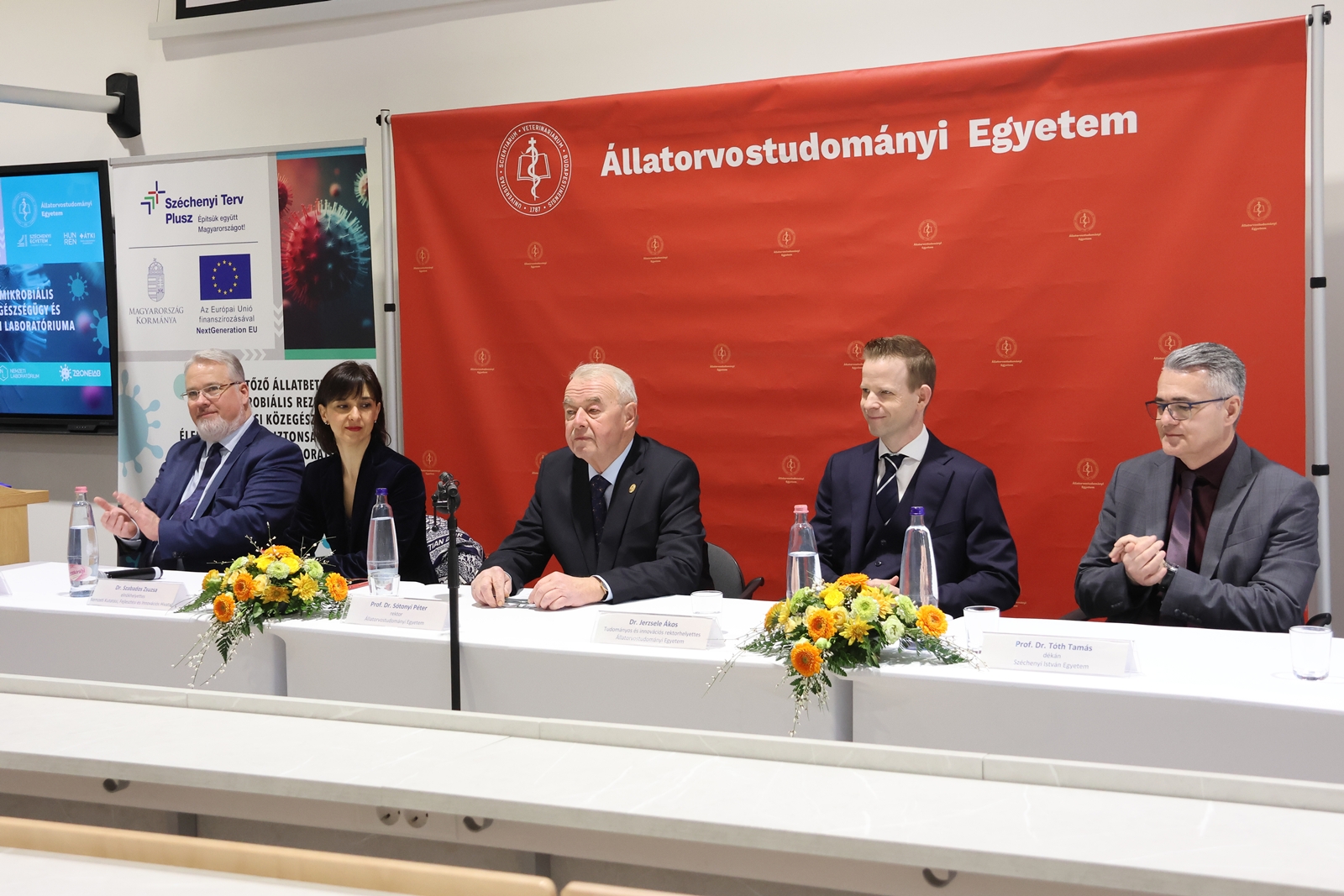
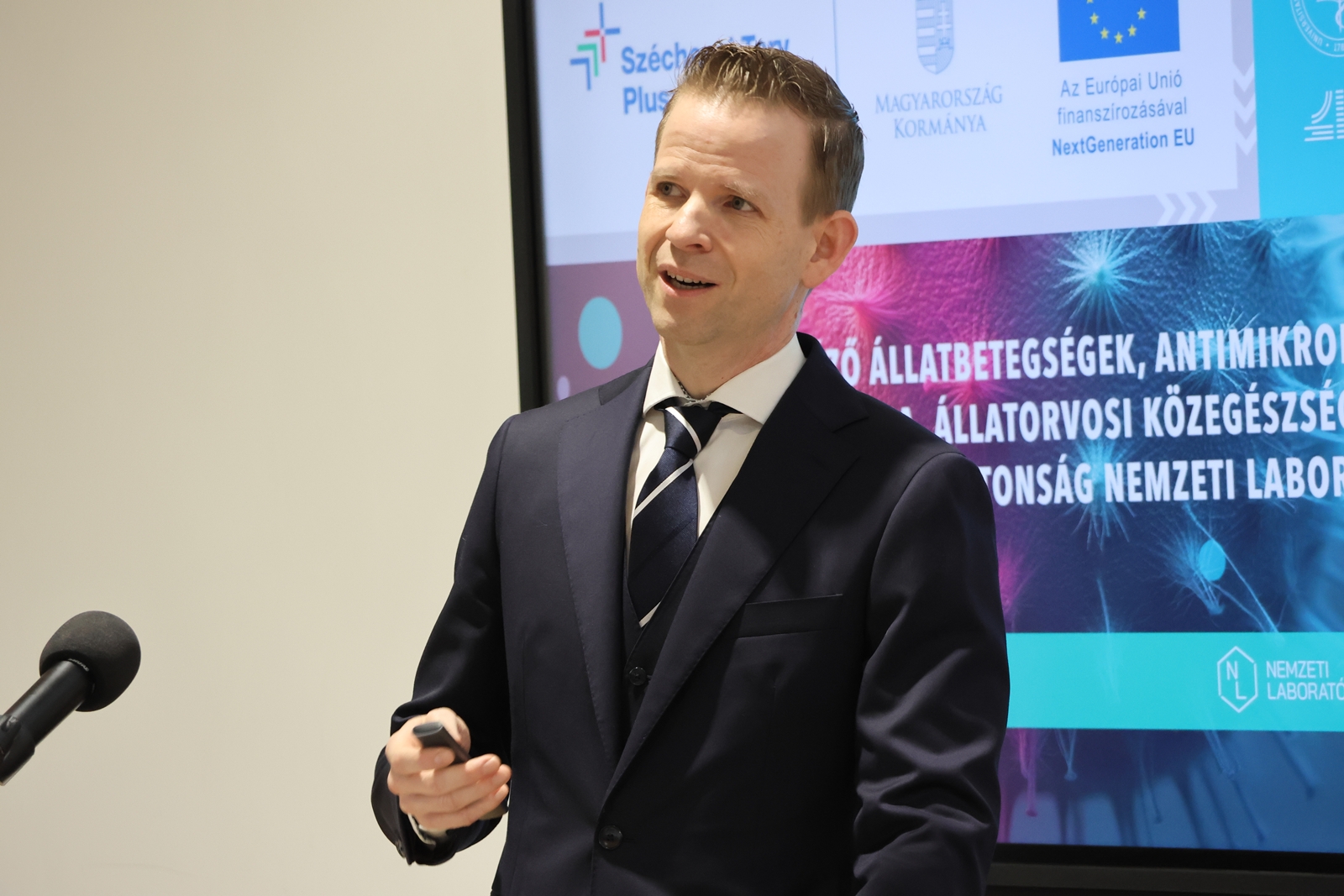
Led by the University of Veterinary Medicine Budapest, in consortium with the HUN-REN Veterinary Medical Research Institute and Széchenyi István University, the project titled “National Laboratory for Infectious Animal Diseases, Antimicrobial Resistance, Veterinary Public Health and Food Chain Safety” (ID: RRF-2.3.1-21-2022-00001) held its closing event on 19 February 2026 at 10:00 a.m. on the University’s István Street campus in Budapest.
The project was implemented with HUF 3.3 billion in funding and focused on research and development aimed at preventing infectious diseases, reducing the risks of antimicrobial resistance (AMR), and developing diagnostics, vaccines, and drug candidates.
We tend to think of AMR as a distant issue. However, it affects our everyday lives – whether in our own kitchens, at the doctor’s office, or while caring for our pets – as it simultaneously impacts human and animal health as well as agriculture. Modern science refers to this as the One Health approach, recognising that what happens in one sector inevitably affects the others.
The University’s National Laboratory, therefore, did not focus on a single field but sought connections: how resistant pathogens emerge and spread, and which practical tools can effectively reduce these risks.
One of the project’s strongest messages is that resistance is not a theoretical problem. Its increase may impose measurable societal burdens in Hungary as well: according to estimates, a 1% rise in AMR could result in 65 additional deaths and 1,800 lost life-years. Accordingly, the research did not target “individual bacteria,” but aimed to draw practice-shaping conclusions from large datasets.
More than 3,000 bacterial isolates were collected and examined, generating nearly 70,000 resistance results, including numerous multidrug-resistant pathogens and several hundred isolates carrying resistance genes that may pose risks to humans.
This chain becomes truly understandable when examined through everyday objects. For example, samples were taken from food delivery containers used in public catering, resulting in the isolation of several hundred E. coli strains, including multiple multidrug-resistant pathogens.
The project also established the necessary infrastructure to support these research outcomes. More than 50 new instruments are now available for use by multiple university units. These include an experimental animal facility (for poultry and rabbits), expanded molecular genetics and sequencing laboratory capacity, and several high-value diagnostic tools, including a MALDI-TOF system enabling rapid and precise bacterial identification.
The project’s impact extends beyond research figures. Experts established 25 domestic and 13 international collaborations and submitted 40 international grant applications, of which 15 were successful. Several industry partnerships were also launched, including the sale of intellectual property rights for a Mycoplasma vaccine development to an international pharmaceutical company. Five industrial property applications were filed during the project.
At the public closing event, attendees received insight into how laboratory findings translate into risk reduction and prevention in practice. Presentations covered complex AMR risk-management data analysis, newly identified swine viruses, phage-based approaches, vaccine candidates, and the potential of probiotic fermented feed.
The project was implemented with funding from the European Union under the Recovery and Resilience Facility (RRF), through non-refundable financial support.